Wednesday, November 28, 2007.
In her earlier post, Jas-さん covered the basics of "this" and "that".

Labels: Grammar and Vocab
Friday, November 16, 2007.
If you still haven't gone to the dictionary and check what is the meaning of "Conjugation", I am not any better.
かえる - kaeru (to go back; to return)


 いる - iru (to need)
 かぎる - kagiru (to limit)
 きる - kiru (to cut)
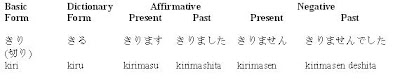 しゃべる - shaberu (to chatter)
 しる - shiru (to know)
 And then there are the Irregular Verbs to contend with. But worry not, there are just 2 of them.
する - suru (to do)

くる - kuru (to come)
 With this post, I would think we have covered the basic rules for now.
~ Rene ~
(Post edit: The dictionary form of the Japanese verbs are informal, present affirmative form used among close friends and family in informal situations.)
Labels: Grammar and Vocab
Verbs what??!!

For the "ru"-verbs, we simply strip the "ru" and then add either "masu" or "mashita" or "masen" or "masen deshita" to it.
For the "u"-verbs:
 For the "u"-verbs, it is slightly more tricky as it requires you to change the "u" into "i" before adding the corresponding parts to it.
That's all for now, I'm sure that committing 10 verbs into memory is a good start!
~ Rene ~
Labels: Grammar and Vocab
Tuesday, November 13, 2007.
Hmm, I always tend to mix up the following expressions below. Thus, I think I'll list them all down for easy reference.
(a)
Who - Dare だれ
Which one - Dore どれ
When - Itsu いつ
Where - Doko どこ
What - Nan/Nani なん
(b)
Somebody - Dareka だれか
Someday - Itsuka いつか
Somewhere - Dokoka どこか
Something - Nanika なにか
From the above, one easy way to remember is just to add a ka for (a) & it'll mean some.... as seen in (b).
Here's another one :
Anyone/Everyone - Dare demo だれでも
Anything - Dore demo どれでも
Anytime - Itsu demo いつでも
Anywhere/Everywhere - Doko demo どこでも
Anything/Everything - Nan demo なんでも
Ok, now's the last one :
(Not) anyone - Dare mo だれも
(Not) any of them - Dore mo どれも
(Not) anytime - Itsu mo いつも
(Not) anywhere - Doko mo どこも
(Not) anything - Nani mo なにも
Some examples :
I read something / Watashi wa nanika yomimasu わたしはなにかよみます
I read anything / Watashi wa nan demo yomimasu わたしはなんでもよみます
I do not read anything / Watashi wa nani mo yomimasen
わたしはなにもよみません
I will go somewhere / Watashi wa dokoka e ikimasu
わたしはどこかへいきます
I will go anywhere / Watashi wa doko e demo ikimasu
わたしはどこへでもいきます
I will not go anywhere / Watashi wa doko e mo ikimasen
わたしはどこへもいきません
Posted By : Jasvale
Labels: Grammar and Vocab
Thursday, November 1, 2007.
A typical conversation asking for time goes like this ...
A: "すみません。いまなんじですか。"
(sumimasen, ima nan ji desu ka.)
Excuse me, what time is it now?
B: "いまさんじにじゅうはっぷんです。"
(ima sanji nijuuhappun desu.)
It is 3:28.
A: "ありがとうございます。"
(arigatoo gozaimasu)
Thank you very much.
B: "いいえ。"
(iie)
Not at all.
***************************
VOCABULARY
***************************
いま (ima) - now
なん or なに (nan / nani) - what
~ Rene ~
Labels: Grammar and Vocab, Time and Date
Wednesday, October 31, 2007.
Ohh, I've been slacking considering my last post was more than a week ago (pictures don't really count, do they?). Whilst I've been slow, Rene has been publishing so many posts on numbers & time ~ i'm really stressed out now!!!! Now look who's the slave-driver (We've been taking turns calling each other that). I've much catching up to do ..
Ok, here's my little contribution. I've covered verbs previously. Now comes the adjectives.
2 types of Adjectives : I-Adjectives & Na-Adjectives.
Below is my list of I-Adjectives (end with i, thus called I-Adjectives)
Warm - Atatakai あたたかい
Cool - Suzushii すずしい
Hot (Temperature & Touch) - Atsui あつい
Cold (Temperature) - Samui さむい
Cold (Touch) - Tsumetai つめたい
Spacious - Hiroi ひろい
Limited space - Semai せまい
Cute - Kawaii かわいい
Ugly - Minikui みにくい
Frightening - Kowai こわい
Gentle - Yasashii やさしい
Difficult - Muzukashii むずかしい
Easy - Yasashii やさしい
Long - Nagai ながい
Short - Mijikai みじかい
Delicious - Oishii おいしい
Bad Taste - Mazui まずい
Big/Large - Ookii おおきい
Small - Chiisai ちいさい
Heavy - Omoi おもい
Light - Karui かるい
Late - Osoi おそい
Early/Quick - Hayai はやい
Near - Chikai ちかい
Far - Tooi とおい
Interesting - Omoshiroi おもしろい
Boring - Tsumaranai つまらない
Expensive/Tall - Takai たかい
Cheap - Yasui やすい
Low/Short - Hikui ひくい
Good - Yoi / II よい / いい
Bad - Warui わるい
New - Atarashii あたらしい
Old - Furui ふるい
Busy - Isogashii いそがしい
Noisy - Urusai うるさい
Fun - Tanoshii たのしい
The adjectives describes nouns & they precede the nouns they describe.
Kore wa mijikai enpitsu desu / This is a short pencil
Koko wa ookii ie desu / This is a big house
I-adjectives with past tense => drop -i, add -katta
Negative I-adjectives => drop -i, add -ku nai
Negative past I-adjectives => drop -i, add -ku nakatta
To make it formal, just add a desu at the back
Let's take the example, Omoshiroi
Omoshiroi hon / The book that is interesting
Omoshiroku nai hon / The book that is not interesting
Omoshirokatta hon / The book that was interesting
Omoshiroku nakatta hon/ The book that was not interesting.
Ok, now lets look at the other type of adjective, ie Na-adjectives.
Convenient - Benri べんり
Inconvenient - Fuben ふべん
Healthy - Genki げんき
Strange - Hen へん
Beautiful - Kirei きれい
Clever - Rikoo りこう
Kind - Shinsetsu しんせつ
Quiet - Shizuka しずか
Famous - Yuumei ゆうめい
Let's take the example, Shinsetsu
Anata wa shinsetsu desu / You are kind
Anata wa shinsetsu dewa arimasen / You are not kind
Anata wa shinsetsu deshita - You were kind
Anata wa shinsetsu dewa arimasen deshita - You were not kind
I think Na-adjectives is much easier, right?
Just to take note when a na-adjective is used, -na must be dropped. However, if a na-adjective is placed before a noun, a -na is added
Yuumei na hito / A famous person
Genki na hito / A healthy person
Okie, I finally finish what I have on adjectives. My mind is now in a blank as to what I should write for my next post (Maybe its late & I'm close to dozing off ^-^ Zzzz time). Please, pls keep reading, thank you v much! I'll be back again once I think of something.
Posted By : Jasvale
Labels: Grammar and Vocab
Monday, October 22, 2007.
The sentence structure :
Indirect subject wa grammatical subject ga "adjective" + desu is used to describe to want something, like/dislike and skills.
To Want
Saying "I want (something)" is pretty easy. Just say the thing you want and add ga hoshii to it.
The negative of hoshii is hoshiku nai
Nomimono ga hoshii desu / I want a drink
Ke-ki ga hoshii desu ka / Do you want cake?
Watashi wa asa-gohan ga hoshiku nai desu / I dont want breakfast
Want To Do
Sentences may be transformed to express wishes by changing o into ga & masu into tai desu
First get the masu form of the verb. Then drop the masu and add tai.
Tabemasu (To eat) becomes Tabetai (Want to eat)
Nomimasu (To drink) becomes Nomitai (Want to drink)
Shimasu (To do) becomes Shitai (Want to do)
Watashi wa hon ga yomitai desu / I want to read a book
Watashi wa hana ga mitai desu / I want to see flowers
Watashi wa netai desu / I want to sleep
Ke-ki o tabetai desu ka / Do you want to eat cake?
Anata wa nani ga shitai desu ka / What do you want to do?
I Dont Want To
You can make negative statements by converting tai desu into either taku arimasen or taku nai desu. The direct object may be followed by either ga or o.
My examples below uses the latter.
Watashi wa hon ga/o yomitaku nai desu
I do not want to read a book
Ototo wa arukitaku nai desu
The younger brother does not want to walk
You can form the negative past tense by changing taku nai desu into taku nakatta desu. The direct object can be followed by ga or o as above.
Kinoo watashi wa benkyou ga/o shitaku nakatta desu
Yesterday, I did not want to study
To Like
It is easy to like something and to say it! Just add ga suki after the object that you like.
For something you dislike, just add ga kirai after the object of dislike.
Watashi wa tenisu ga suki desu / I like tennis
Watashi wa ninjin ga kirai desu / I dislike carrots
Anata wa nani ga suki desu ka / What do you like?
The negative of suki/kirai desu is suki/kirai de wa arimasen
Betty-san wa ringo ga suki de wa arimasen / Betty does not like apples
I Am Good At That
Good (at a particular skill) / Jouzu
Bad (at a particular skill / Heta
Ojiisan wa Nihon-go ga jozu desu / Grandfather is good at Japanese language
Below are addditional information :)
I Think
You believe what you say, but are not 100% sure. It is also used to show one's opinion, just add to omoimasu at the end.
Sakana wa oishii to omoimasu / I think fish is delicious
Become
To show the state of to become something, use ni narimasu. The ni is placed after what is becoming something. The narimasu means to become. Nouns and -na adjectives use ni narimasu.
The negative future tense is obtained by changing narimasu into narimasen
Yoru ni narimashita / It has become night (mashita shows past)
Tomodachi ni narimashou / Let's become friends (mashou means "Let's")
Yoru gakkou wa shizuka ni narimasu / At night, school will be quiet
Ashita wa atsuku narimasen / It will not be hot tomorrow
-Ing
This is a very important grammar point. It corresponds to the English "-ing" form.
It is used to describe things happening now.
To use the form, change the first verb into the 'te' form. Then add the 'imasu'.
Ima anata ni hanashite imasu / I am talking to you now
Ima gohan o tabete imasu / I am eating rice now
This form is also used when stating things that are done on a regular basis (even if you are not presently doing the activity)
Mai nichi, nihongo o ichi jikan benkyou shite imasu / Everyday, I study Japanese for an hour.
Ok, I hope the above information & examples helps :))
Posted By : Jasvale
Labels: Grammar and Vocab
One of the characteristics of the Japanese language is that the verb generally comes at the end of the sentence. Since Japanese sentences often omit the subject, the verb is probably the most important part in understanding the sentence
Masu-verbs are used for the polite style of speech, which is the most commonly used style.
Its appropriate for general use so I'll be using only masu-verbs in my notes.
Below is a list of masu-verbs which I've came across. The list is not exhaustive though, I'll add on more as & when I come across them :)
Too many words to learn at one go, isn't it? Probably you can start to memorise a few at a time till such time when the words just come naturally to yr mind & you can proceed on with the next few & so forth! Well, learning japanese has made me feel like a small small kid all over again learning how to write, speak & understanding its meaning. Learning is really fun, ya?
(Have to tell yrself its fun even when it's too hard, ya?) SO, even if the going gets tough, try motivating yourself & persevere!
A new language if mastered well is both a skill & an asset, agree? YES!!!
Wash - Araimasu あらいます
Speak - Hanashimasu はなします
Buy - Kaimasu かいます
Sell - Urimasu うります
Write/Draw - Kakimasu かきます
Listen to/Hear - Kikimasu ききます
See/Watch - Mimasu みます
Learn - Naraimasu ならいます
Drink - Nomimasu のみます
Eat - Tabemasu たべます
Take - Torimasu とります
Send - Okurimasu おくります
Make - Tsukurimasu つくります
Read - Yomimasu よみます
Wait - Machimasu まちます
Sleep - Nemasu ねます
Know - Shirimasu しります
Play - Asobimasu あそぶます
Walk - Arukimasu あるきます
Go - Ikimasu いきます
Come - Kimasu きます
Leave - Demasu でます
Do - Shimasu します
Return - Kaerimasu かえります
Meet - Aimasu あいます
Enter - Hairimasu はいります
Begin - Hajimarimasu はじまります
Have - Mochimasu もちます
Think - Omoimasu おもいます
Sit - Suwarimasu すわります
Stand - Tachimasu たちます
Wake Up - Okimasu おきます
Stop - Tomarimasu とまります
Arrive - Tsukimasu つきます
Sing - Utaimasu うたいます
Understand - Wakarimasu わかります
Laugh - Waraimasu わらいます
Teach - Oshiemasu おしえます
Get off - Orimasu おります
Present Tense
Japanese verb forms have two main tenses, the present and the past. There is no future tense. The present tense is used for future and habitual action as well.
Past Tense
The past tense is used to express actions completed in the past (I saw, I bought etc.) and present perfect tense (I have read, I have done etc).
Take off ~masu , and add ~ mashita
Present Negative
To make sentence negative, verb endings are changed into negative forms
Replace ~ masu with ~ masen
Past Negative
Add ~ deshita to the formal present negative form
Examples :
Present Tense
1) Nomimasu
2) Tabemasu
3) Mimasu
Past Tense
1) Nomimashita
2) Tabemashita
3) Mimashita
Present Negative
1) Nomimasen
2) Tabemasen
3) Mimasen
Past Negative
1) Nomimasen deshita
2) Tabemasen deshita
3) Mimasen deshita
Forming Sentences
Otoosan wa shinbun o yomimasu / Father reads newspapers
Watashi wa nihon-go o naraimasu / I learn Japanese
Imooto wa pan o tsukurimasu / The younger sister makes bread
Would you like to __?
Negative masu-verbs + ka means Would you like to __?
Eiga o mimasen ka / Would you like to see a movie?
Kore o yomimasen ka / Would you like to read this?
Posted By : Jasvale
Labels: Grammar and Vocab
Sunday, October 21, 2007.
Japanese has many different words for this & that. When you talk about a thing or person, Kore, Sore & Are are used.
Kore これ - This (indicates a thing/person near the speaker)
Sore それ - That (indicates a thing/person near the listener)
Are あれ - That over there (indicates a thing/person away from the speaker & listener)
Dare だれ - Who
Dore どれ - Which
Kore is used when "this" is not connected to a noun
Kore wa nan desu ka / What is this?
Kore wa neko desu / This is a cat.
When you put "this" before a noun, it changes to Kono (この)
Kono neko wa pochi desu ka / Is this cat, Pochi?
Iie kono inu wa pochi desu / No. This dog is Pochi.
Similarly, When you put "that" & "that over there" before a noun, it changes to Sono (その)& Ano (あの)respectively.
When you refer to other people to whom you have to show yr respect, such as teachers or elders, Kochira (This), Sochira (That) & Achira (Over there) are used.
When you talk about this & that related to a place, Koko, Soko & Asoko are used.
Koko - This place (a place near the speaker)
Soko - That place (a place near the listener)
Asoko -That place over there (a place away from speaker & listener)
Doko - Where
Posted By : Jasvale
Labels: Grammar and Vocab
language is an instrument to thought
Nihongo ala My WayContributors
Words
Links
Dainty BitesTopics
IntroductionGrammar and Vocab
Hiragana
Katakana
Links
Numbering
Food For Soul
Time and Date
Archives
This, That, and (That) Over there - Part 2
Verbs Conjugation (Part 2)
Verbs Conjugation
Some & Any Expressions
じかん (jikan) - How to ask for time
Adjectives
Basic Grammar
Verbs ~ Action Words
This, That, and (That) Over there